Best Mem0 Alternatives for Enterprise AI Applications
Mem0 alternatives like Zep, MemoryOS, and SimpleMem address enterprise AI's critical memory challenges through temporal knowledge graphs, GPU-optimized architectures, and compression pipelines. Zep leads benchmarks with 17% higher accuracy and 60% faster performance than Mem0, while SimpleMem reduces inference costs by 97% through semantic compression.
Key Facts
Enterprise AI memory systems must handle temporal reasoning, compliance requirements, and scale to billions of documents without latency degradation
Zep achieves 94.8% performance on Deep Memory Retrieval benchmarks through its Graphiti temporal knowledge graph engine
SimpleMem compresses context from 17,000 to 550 tokens per query while maintaining 26% higher F1 scores than Mem0
MemoryOS delivers 49% F1 improvement on LoCoMo through GPU-optimized architecture
Leading alternatives offer managed cloud, self-hosted, and on-premises deployment options for different compliance needs
Cortex achieved 90.23% accuracy on LongMemEval-s, the highest reported score for temporal reasoning tasks
Large language models are powerful, but they share a fundamental flaw: they forget. "Ever noticed how ChatGPT seems to forget what you were talking about after just a few messages? It's not just you—it's a fundamental limitation of all LLM-based applications," as one AI memory evaluation puts it. For enterprise teams building production AI agents, this context loss creates real problems.
As organizations scale their AI deployments, the search for robust Mem0 alternatives has intensified. The stakes are high. Context rot degrades response accuracy over time. Compliance risks multiply when memory systems fail to properly track and audit information. And the total cost of ownership for fragmented memory stacks can spiral quickly.
The vector database segment alone is projected to expand at a CAGR exceeding 22% through 2030, reflecting how seriously enterprises are taking the memory challenge. Modern AI tools like ChatGPT, Claude, and Gemini forget everything about you the moment you switch tools or hit a token limit.
This guide examines the leading Mem0 alternatives available today, with objective benchmarks and practical guidance for CTOs and engineers building production-grade AI agents. Systems like Cortex and Zep demonstrate how memory-first architectures outperform traditional vector approaches in long-horizon reasoning tasks.
Why are enterprises searching for Mem0 alternatives?
The core problem is simple: LLMs lack persistent memory. Each interaction starts from scratch, forcing enterprises to rebuild context repeatedly. This creates inefficiencies that compound at scale.
Enterprise AI memory requirements go far beyond basic conversation history. Production agents need to:
Track user preferences across sessions
Maintain temporal awareness of how facts evolve
Integrate structured business data with conversational context
Support compliance and audit requirements
Scale to billions of documents without latency degradation
The challenge intensifies as AI agent deployments grow. What works for a prototype often breaks in production. Teams discover that simply enlarging context windows actually makes responses less accurate, a phenomenon researchers call "context rot."
A well-designed pipeline can elevate simple LLM outputs into rich, context-aware interactions. But building that pipeline from scratch requires assembling vector databases, embedding models, knowledge graphs, chunking logic, and retrieval orchestration. Most teams find this stack fragile and expensive to maintain.
Where Mem0 shines -- and where it falls short
Mem0 has earned its popularity for good reasons. It is a developer-first, vendor-agnostic memory layer designed for teams that want control over their memory component.
Mem0's strengths include:
Easy integration with simple APIs that slide into existing LLM stacks
Vendor-agnostic design that works with different model providers and storage backends
Focus on long-term and entity-style memory
On the LOCOMO benchmark, Mem0 achieves +26% accuracy and 91% lower latency versus full-context approaches
However, Mem0 presents challenges for enterprise deployments:
You own the infrastructure. Mem0 doesn't remove ops work -- you still run storage, retrieval, and monitoring
The latest API returns timestamps in PDT, requiring timezone normalization for correct temporal reasoning
Limited native support for temporal knowledge evolution
No built-in Graph RAG or automated context assembly
Mem0 remains the better choice when you want a memory component you control and you're comfortable managing the infrastructure. But teams needing temporal reasoning, compliance-grade audit trails, or self-improving retrieval often find themselves outgrowing Mem0's capabilities.
What benchmarks matter when comparing memory layers?
Two benchmarks have emerged as industry standards for evaluating AI agent memory:
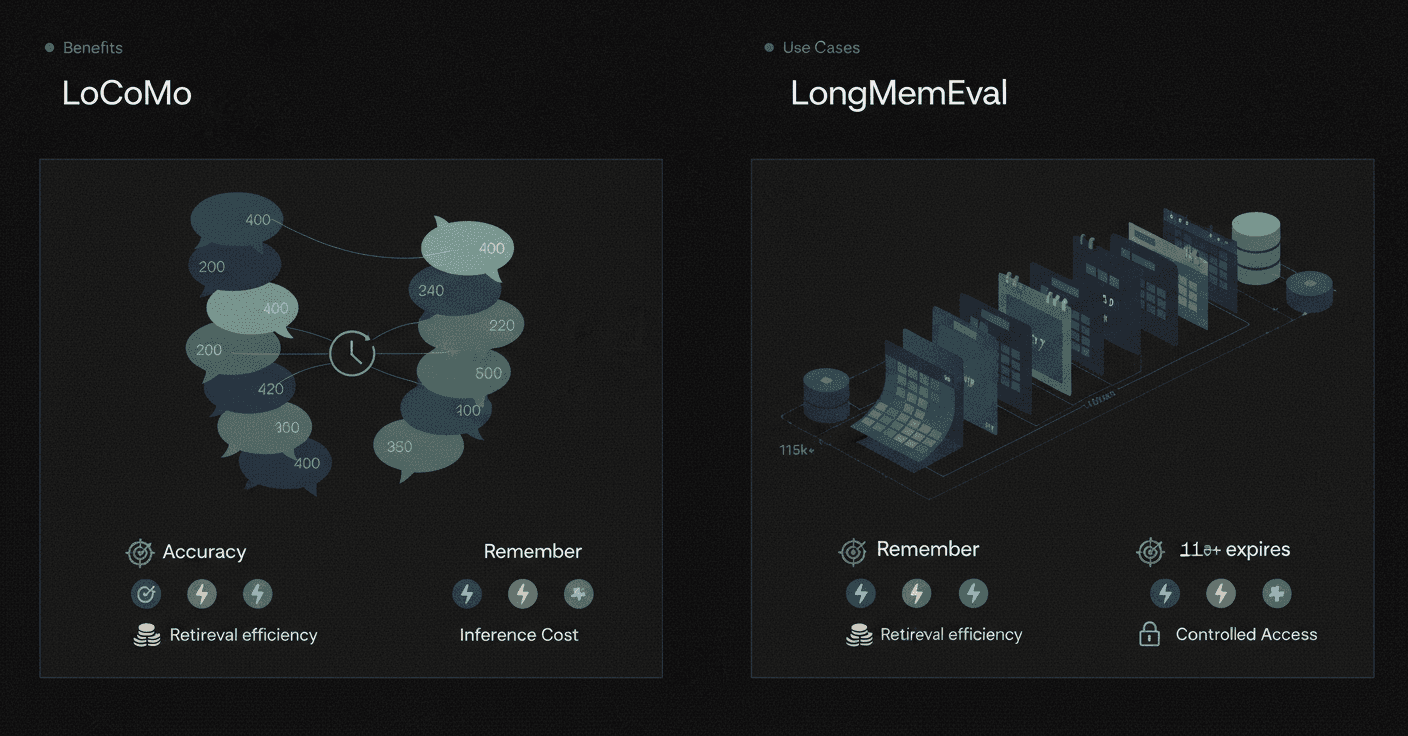
LoCoMo (Long-Context Memory) is a synthetic benchmark simulating multi-turn dialogues of 200 to 400 turns. It tests how well an agent retains and retrieves information over extended conversations. LoCoMo evaluates accuracy, retrieval efficiency, and inference cost.
LongMemEval focuses on real-world enterprise conditions where identity, preferences, timelines, and knowledge evolve across hundreds of sessions. It tests multi-session reasoning with massive contexts exceeding 115,000 tokens per stack. Cortex achieved 90.23% overall accuracy on LongMemEval-s, demonstrating particularly strong performance in temporal reasoning and knowledge updates.
Using a unified, production-grade evaluation framework, researchers have benchmarked leading memory systems including EverMemOS, Mem0, MemOS, Zep, and MemU under identical conditions.
Key scoring dimensions include:
Capability | What It Measures |
|---|---|
Single-session recall | Remembering facts from current conversation |
Preference application | Applying user preferences correctly |
Knowledge updates | Handling changed or corrected information |
Temporal reasoning | Answering time-dependent queries accurately |
Multi-session reasoning | Synthesizing information across conversations |
Experiments on these benchmarks show that SimpleMem achieves an average F1 improvement of 26.4% on LoCoMo while reducing inference-time token consumption by up to 30-fold. This demonstrates that more context is not better context -- structured memory outperforms raw retrieval.
1. Zep -- temporal knowledge graph memory layer
Zep leads current benchmarks as an enterprise-grade Mem0 alternative. On the LoCoMo benchmark, Zep is 17% more accurate and 60% faster than Mem0 while using 45% fewer tokens.
The core differentiator is Graphiti, Zep's temporally-aware knowledge graph engine. Unlike systems that treat memories as static documents, Zep tracks how facts change over time, combining conversations with structured business data.
On the LongMemEval benchmark, Zep achieves accuracy improvements of up to 18.5% while reducing response latency by 90% compared to baseline implementations.
Key capabilities:
Temporal reasoning that handles fact changes and recency
Graph RAG with automated context assembly
Business data integration alongside conversational memory
Enterprise compliance certification for regulated environments
"Zep just introduced a game-changing way for AI agents to remember and learn. Unlike other systems that only retrieve static documents, Zep uses a temporal knowledge graph to combine conversations and structured business data, keeping track of how things change over time," notes one industry analysis.
Zep works well for teams that need durable memory beyond simple vector recall, particularly in regulated industries where temporal accuracy and audit trails matter.
2–5. Other notable Mem0 alternatives
Beyond Zep, several specialized memory systems address different enterprise requirements:
MemoryOS -- GPU-optimized context compression
MemoryOS takes a different architectural approach, achieving state-of-the-art results on LoCoMo with +49% F1 improvement.
Its GPU-optimized architecture addresses a gap in current solutions like LangChain and LlamaIndex, which rely on CPU-based vector operations. MemoryOS suits teams with heavy computational requirements who can leverage GPU acceleration for memory operations.
MemMachine -- open source & on-prem friendly
MemMachine offers an open-source, multi-layered memory system with distinct episodic and profile memory types. With 4,616 stars and Apache 2.0 licensing, it has built an active community.
The system is designed with security in mind -- the open-source version can be deployed in private cloud or on-premises environments for full data control. It supports multiple AI models simultaneously, including specialized models hosted privately.
MemMachine integrates with LangChain, LangGraph, CrewAI, LlamaIndex, and other frameworks. For teams prioritizing data sovereignty and deployment flexibility, it provides a strong foundation.
SimpleMem -- token-efficient compression pipeline
SimpleMem focuses on efficiency through semantic lossless compression. The results are striking: it slashes inference costs by 97%, reducing context from roughly 17,000 tokens to just 550 tokens per query.
The three-stage pipeline -- Semantic Structured Compression, Online Semantic Synthesis, and Intent-Aware Retrieval Planning -- achieves 26% higher F1 scores than Mem0. SimpleMem also enables 4x faster response times compared to graph-based memory systems.
At GPT-4o pricing, SimpleMem reduces per-query costs from approximately $0.042 to $0.0014. For teams running high-volume inference, this translates to substantial savings.
Letta (formerly MemGPT)
Letta has over 17,000 GitHub stars and provides a stateful agents framework with memory, reasoning, and context management. Agents persist indefinitely by storing data in PostgreSQL or SQLite.
The system call interface supports programmatic memory mutation through operations like memoryreplace, memoryrethink, and memory_append. Letta is open source and designed for teams building complex agent architectures.
How to choose the right memory layer for your stack
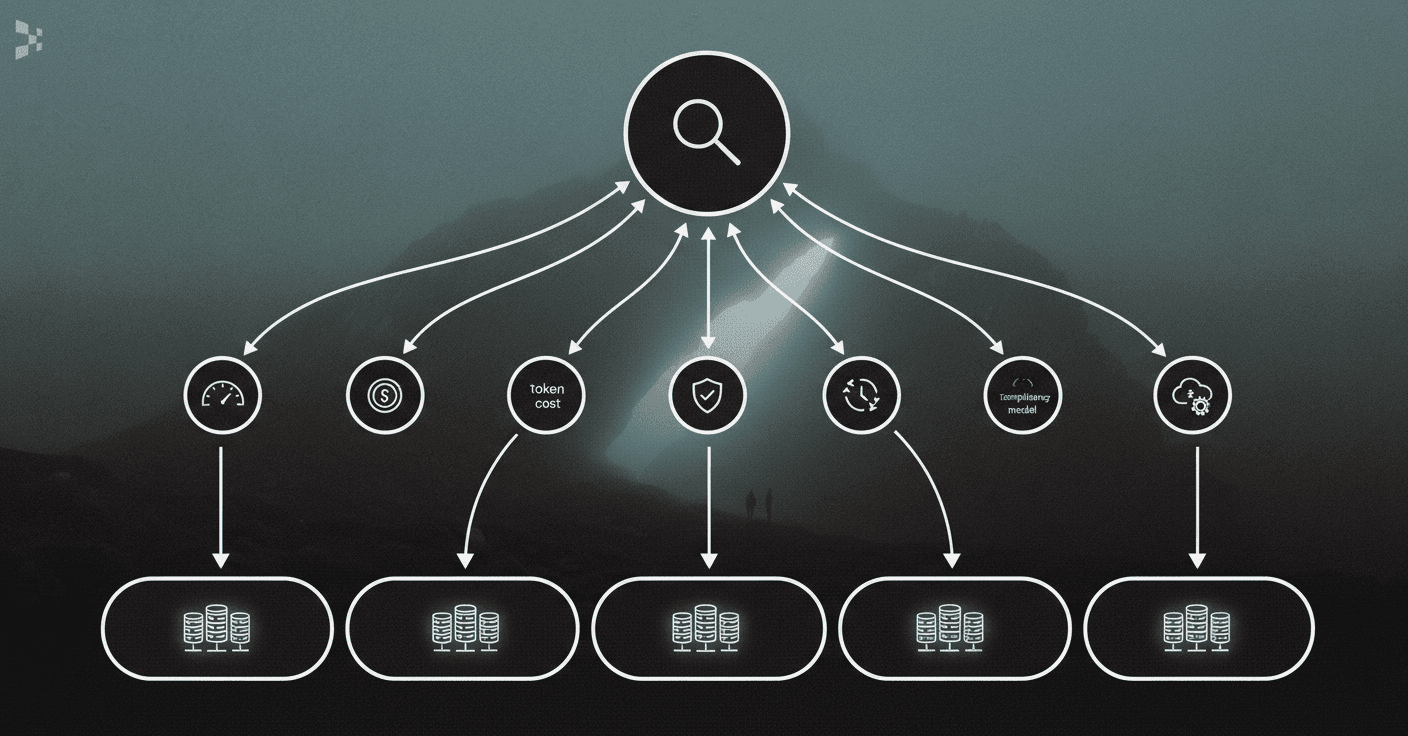
Selecting a memory system requires evaluating several dimensions:
Latency requirements
Production agents need sub-second responses. Zep reduces latency by 90% compared to baselines. SimpleMem achieves 4x faster response times through compression. Evaluate p50 and p95 latencies under realistic load.
Token cost
Memory systems vary dramatically in token efficiency. SimpleMem cuts token usage by 97%. Zep uses 45% fewer tokens than Mem0. At scale, these differences determine whether your AI deployment remains economically viable.
Compliance and security
Enterprise deployments require audit trails and compliance certifications. Zep maintains SOC 2 Type II certification with HIPAA compliance, role-based access control, and BYOK encryption. Mem0 offers SOC 2 Type I with HIPAA readiness. MemMachine provides on-premises deployment for maximum data control.
Hosting model
Option | Best For |
|---|---|
Managed cloud | Teams wanting minimal ops overhead |
Self-hosted | Organizations with data residency requirements |
On-premises | Regulated industries with strict data controls |
BYOC (Bring Your Own Cloud) | Enterprises needing cloud flexibility with control |
Temporal reasoning
If your agents need to answer questions like "What was my preference before last month?" or track how facts evolve, prioritize systems with native temporal support. Zep's temporal knowledge graph handles this natively.
Integration requirements
Consider compatibility with your existing stack. Most memory systems integrate with LangChain, LlamaIndex, and similar frameworks. MemMachine includes native Model Context Protocol (MCP) support for Claude Desktop and Cursor.
Key takeaway: Start with your hardest requirement -- whether that's latency, compliance, cost, or temporal reasoning -- and eliminate options that don't meet it before evaluating secondary factors.
Conclusion: future-proofing enterprise agents with smarter memory
The gap between vector databases and production-grade memory systems continues to widen. Vector stores act as stateless lookup tables. They lack persistent memory, temporal awareness, and the ability to learn from interactions.
Modern memory layers like Zep, MemoryOS, MemMachine, and SimpleMem represent a different approach. They preserve context across sessions, track knowledge evolution, and reduce the infrastructure burden on engineering teams.
The benchmarks are clear: structured memory systems outperform raw retrieval approaches by 20% to 50% on accuracy while dramatically reducing costs. For teams building production AI agents where accuracy, latency, and compliance matter, the investment in proper memory architecture pays dividends.
For organizations seeking a fully integrated approach, Cortex provides a self-improving retrieval and memory platform that combines enterprise data, context-aware knowledge graphs, and built-in memory in a single layer. It achieved 90.23% accuracy on LongMemEval-s -- the highest reported score to date -- with particular strength in temporal reasoning and knowledge updates.
The choice of memory system will define whether your AI agents can maintain coherent, accurate, and compliant behavior over the long conversations and evolving contexts that enterprise deployments demand.
Frequently Asked Questions
What are the main challenges with Mem0 for enterprise AI applications?
Mem0 presents challenges such as the need for infrastructure management, limited support for temporal knowledge evolution, and lack of built-in Graph RAG or automated context assembly, making it less suitable for enterprises needing compliance-grade audit trails or self-improving retrieval.
Why are enterprises seeking alternatives to Mem0?
Enterprises seek alternatives to Mem0 due to its limitations in persistent memory, temporal reasoning, and compliance requirements. As AI deployments scale, the need for robust memory systems that can handle evolving contexts and maintain accuracy becomes critical.
What benchmarks are used to evaluate AI memory systems?
Two key benchmarks are LoCoMo, which tests multi-turn dialogue retention and retrieval efficiency, and LongMemEval, which evaluates multi-session reasoning in real-world conditions. These benchmarks assess capabilities like temporal reasoning, knowledge updates, and preference application.
How does Cortex compare to other memory systems?
Cortex stands out with its self-improving retrieval and memory platform, achieving 90.23% accuracy on LongMemEval-s. It excels in temporal reasoning and knowledge updates, offering a fully integrated approach that combines enterprise data and context-aware knowledge graphs.
What are the benefits of using Zep as a Mem0 alternative?
Zep offers advantages like temporal reasoning, automated context assembly, and business data integration. It is particularly suitable for regulated industries due to its enterprise compliance certification and ability to track fact changes over time.